
Current or future executive in women’s football marketing, this is for you.
Here you will find a guide to build a successful brand in women’s football, either for a player, club, tournament or national association.
All yours.
1. First, 3 questions
Before starting, you will need to answer these 3 questions to set the right direction for your brand.
1.1 Who is it for?
Describe, with maximum detail, who you want to connect with your brand. E.g. Women from 18 to 35 years old in London who love women’s football and practice sports on a weekly basis.
1.2 What is it for?
Make clear what is the main benefit your brand will provide your audience with. Be relevant, personal and authentic. E.g. Making the target market feel proud and connect with each other within a local community of women in sports.
1.3 How will you know if it’s working?
Define how you are going to measure success or failure. E.g. On a regular basis, looking at how many women are joining the community and how many take part of activities.
2. Brand influence
Let’s get started. In this phase, we will do the analysis work to build from strengths (only for existing brands).
2.1 Digital Audit
Have a deep a look at all current digital active platforms, including social media and web. Look at evolution in terms of followers, content, engagement, reach, web visits, clicks and fans’ feedback. Semrush is very useful for web analysis.
2.2 Benchmark
Compare your results to competition, looking at top websites and social media platforms in your market. It will give us a more accurate perspective of where we are.
2.3 Follower Analysis
Analytics from social media and Google Analytics will help us to describe followers and users. We want to know everything, from demographics to behaviour, attitude and interests.
2.4 Brand Evolution Curve
Time to illustrate the evolution of our brand. Over time, measure how engagement, followers or reach has evolved. Use your social media analytics or Influencer Marketing Hub, which with is very easy and fast to get followers’ evolution.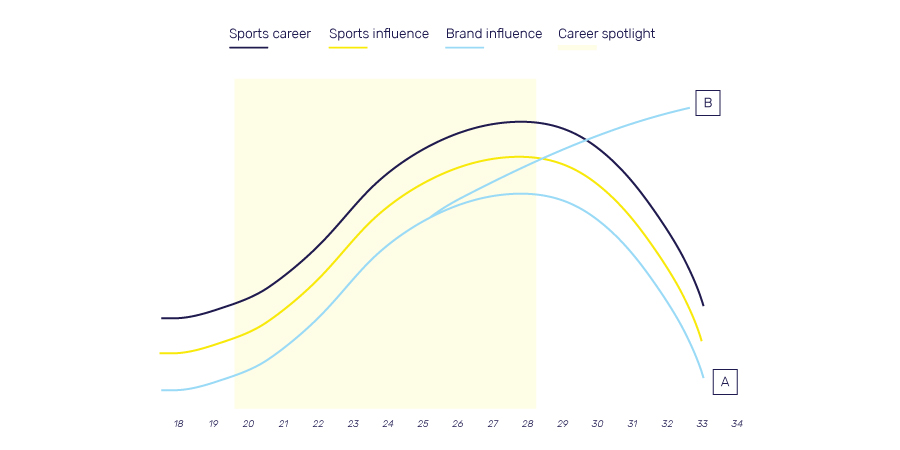 Players Brand Evolution Curve example
This is an example of athletes’ brand evolution curve.
A. Brand influence is born, grows, plummets and die.
B. Brand influence is born, grows and keeps growing within retirement.
From the brilliant book Athletes Are Brands Too written by Jeremy Darlow, we can have a more accurate idea of the effect of managing athletes’ brands and also the poor results of not leveraging the potential of an athlete.
According to Darlow, the spotlight and maximum influence of any athlete during her career is from their 24s until 28s on average. That’s not exclusively when the brand has to be developed, the right time is at the beginning so the brand influence skyrockets when the athlete reaches the peak of her sports career.
3. Brand positioning
Once we know where we come from, let’s write down the spirit of the brand we want to become.
3.1 Buyer persona
Describe extensively the target market you want to reach. Age, sex, attitude, behaviour, hobbies, pains, needs, job, salary, day to day, goals, purchasing power, education level, everything.
3.2 Values and personality
State which are your brand’s 3 core values and personality. Not how it can be currently perceived but how do you want it to be remember for. Imagine, how would it be like if it was a person?
3.3 Brand story
Write down the story of your brand from a marketing perspective. Focus on 3 elements: Hook, Plot and Resolution. Look for game-changing moments that articulate a story with purpose and meaning.
3.4 Positioning statement
Unite your frame of reference and your differentiation point. This is how you want your fans to think of your brand. For instance, Marta Vieira is [the best player ever] + [in women’s football].
Here you have some useful questions to know your brand better if you are working with athletes:
- What is your favourite colour?
- What colour represents you?
- What do your clothes say about you?
- What is your favourite quote?
- What is your favourite car?
- Is there a word or sentence you say a lot?
- What is your favourite emoji?
If you work for a club, these can help you:
- What makes your sport special
- What is your essence?
- What is your added value?
- What do people love about your city?
- What traditions do you engage with?
- What’s your story?
- What are you doing interact with stakeholders?
4. Brand voice
Now we know who we are and who we want to be, let’s design the strategy to achieve our goals.
4.1 Goals and KPI’s
Define the main objectives of your brand. Reach, interaction, followers and revenue are the according KPI’s for awareness, engagement, community and monetisation goals. Pick your stage, goal and KPI.
4.2 Platforms and functions
Considering your buyer persona, decide through which platforms you will aim to achieve your goals. They can be offline and online and under constant evolution considering your fans’ behaviour.
4.3 Content territories
Build your content plan, defining what you are going to talk about and when, where, for who and how. Consider paid media as Google Adwords or Social Media ads as a potential part of your content.
4.4 Calendar
Write down what kind of content will be distributed, under which channels and who will be responsible for it. Sport and football is in constant change, so having an adaptable monthly calendar can be effective.
5. Action and control
This phase is when we execute, measure, learn and optimise our strategy to accomplish our goals effectively.
5.1 Execution
Go ahead and make real the plan you have built for your brand. Mind the learning process you will be at and gather the more information as possible from your audience, they will be key to next calendar adjustment.
5.2 Dashboard
Goals and KPI’s described in the previous step need to be controlled and measured. You will need to design a practical document to track your performance and facilitate your decision-making looking at results.
5.3 Monthly report
As you might have to report to another colleague or maybe yourself, elaborating a monthly report that contains an updated version of the dashboard with potential improvements can be very practical.
5.4 Calendar adjustment
From your own experience, adapt the calendar to next month and increase the content territory that drove more attention. In this stage, budget for paid media and campaigns are also optimised.
When building your brand, bear in mind the core ingredients that make women’s football special.
Photo credit: Deskgram.net