
Japanese women’s football has taught us, for many years, a valuable lesson about doing more with less.
More titles and awareness with less participation and resources than top national associations. With only 51,000 registered players, in comparison to 1.3M in United States, 290,000 in Canada or 197,000 in Germany, the women’s national team has been ranked among the top 6 over the last ten years.
Winners of the 2011 FIFA Women’s World Cup and the 2018 U-20 FIFA Women’s World Cup, despite counting with less support from the federation than countries with similar level on the pitch and without having had a women’s football department for many years.
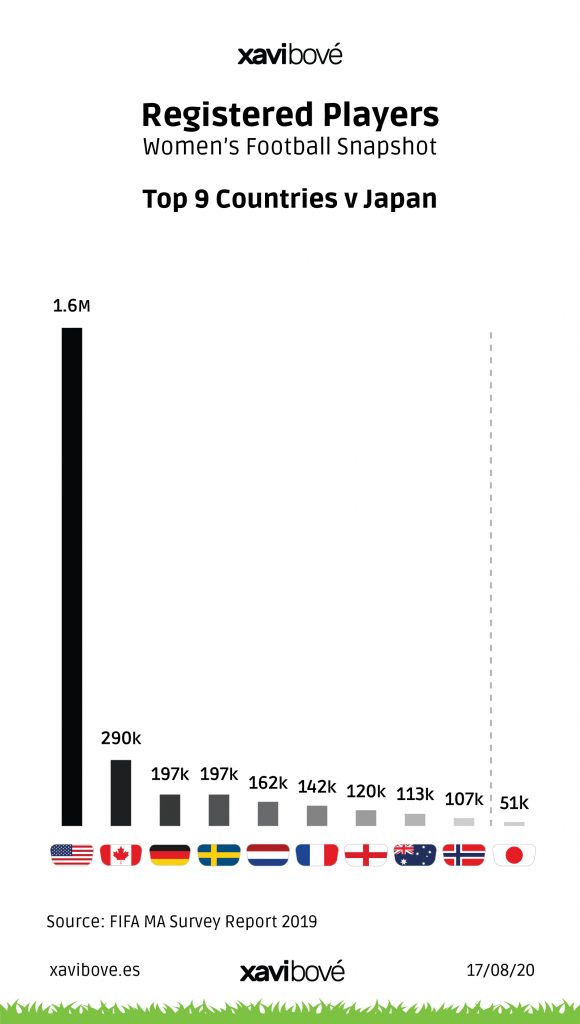
However, a new chapter for Japanese women’s football has already started.
Before the Nadeshiko League officially returned on July 18th after the pandemic, the Japan FA announced the launched of the first-ever women’s professional league in the country. The WE League, Women Empowerment League, will aim to “build a sustainable society through promoting female social participation”, according to Tashima Kohzo, president of the JFA.
Despite the fact that JFA decided to withdraw from the bid to host the next World Cup due to COVID-19, the main strategic objectives of the federation remained intact: reaching 300,000 registered female players by 2030, becoming champions at Tokyo Olympics and FIFA Women’s World Cup 2023 and growing talent through global standards.
A pioneering club in Kobe
Like in other countries such as United States or the Netherlands, the women’s national team has experienced a sustainable and significant growth while domestic competitions have lacked of visibility and investment for many years. Now, the NWSL and the Eredivisie are taking bold steps to minimise that gap, and so is the JFA.
At a club level, I had the privilege to talk with one of the game-changing leaders in Japanese women’s football, Takashi Yasumoto, President of INAC Kobe Leonessa, three-time winners of the Nadeshiko League. After a successful career in business and football, having worked at Rakuten and served as Managing Director for Crimson Football Club, today Vissel Kobe, he joined INAC Kobe in 2018.
Since Yasumoto’s arrival, INAC Kobe has started to show how women’s football clubs can enhance its commercial value, attracting record fan attendances of more than 5,300 spectators and growing a total revenue of $1M. A successful case study in the field of sponsorship, as brands like Kawasaki, Rakuten and BMW have helped the club reach partnership revenues around 70 million yen (about 660,000 dollars).
Leveraging its relationship with the community has been key for the fully-professional club, particularly with young girls and women in schools and universities. An opportunity to build participation and engagement with the players, considered role models for the future generations. With partners, the president has also made an effort to develop meaningful relationships by connecting with sponsors’ families and employees too.
“First, we need to grow awareness through valuable content in order to monetise our commercial value afterwards”. According to Yasumoto, platforms like YouTube and MyCujoo have been excellent channels to awaken the interest from society by exposing the attractive of the Nadeshiko League, where only about 20% of the players compete professionally.
As Takashi Yasumoto shared in the following interview, in Spanish, Japanese women’s football is expected to have a bright future ahead if society and stakeholders recognise its potential and impact in culture. From a club perspective, the new WE League in 2021 will lead clubs to develop a more competitive game through professionalisation. At a global scale, the national team will aim to break barriers in the country in great challenges as the Olympics and the World Cup.
Thanks to Christian Isshiki, professional translator and interpreter, for his kindness in translating the interview.