

A marketing director at a well-known brand told me how her budget was cut by 20% during 2026.
The reason?
The company needed to reduce costs to meet its profit target.
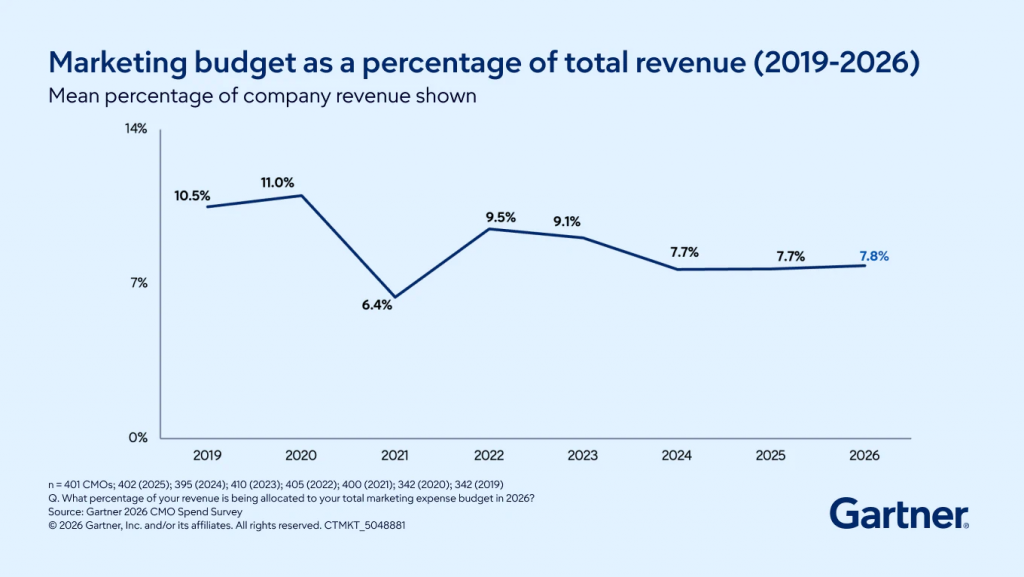
The data shows the greatest instability in marketing budgets since the pandemic.
Today, they represent 7.8% of total revenue, compared with 11% in 2020.
In 2021, Just Eat began its partnership with Uefa, including the men’s and women’s Champions League, the European Championship, as well as futsal and youth competitions.
With food delivery booming during the pandemic, the sponsorship was a success. Just Eat was growing at an impressive annual rate of 100%.
People who knew about the Uefa partnership not only saw Just Eat as a more premium brand but also placed more orders on the platform.
The problem was that, after COVID-19, food orders slowed down, resulting in a significant decline in sales.
Even so, in 2024, the contract was renewed until 2027.
In September 2026, with one year remaining on the contract, the partnership was terminated early.
The sponsorship, valued at more than USD 50 million per year, had become unsustainable for the company’s finances given its current revenues.
Without knowing the story from the inside, this example leads to the following reflections:
- A sponsorship doesn’t just compete with other marketing projects, but with many business decisions: opening a new factory, launching a product, expanding into a new country or reducing costs.
- We need to follow company and industry cycles to understand how sponsorships can adapt to constant change.
- Generating short-term sales results tends to provide greater protection for a sponsorship when company decisions could put the partnership at risk.
- Ending a contract is common. Sports properties and brands need to be prepared commercially, reputationally and legally to mitigate potential damage.
- A constant and close relationship with the sponsor’s leadership is essential to demonstrate the value of the partnership and anticipate potential challenges.
- CMOs are under increasing pressure to deliver immediate business results, making marketing budgets more vulnerable to cuts.
Sponsorships don’t just compete with other marketing investments, they compete with every priority across the business.
A sponsorship that made perfect sense two years ago may no longer make sense today. Not necessarily because it has stopped delivering value, but because the company has changed.
The numbers need to add up every year.
Receive my content